A review: Kim Jiyoung, born 1982, Cho Nam-Joo
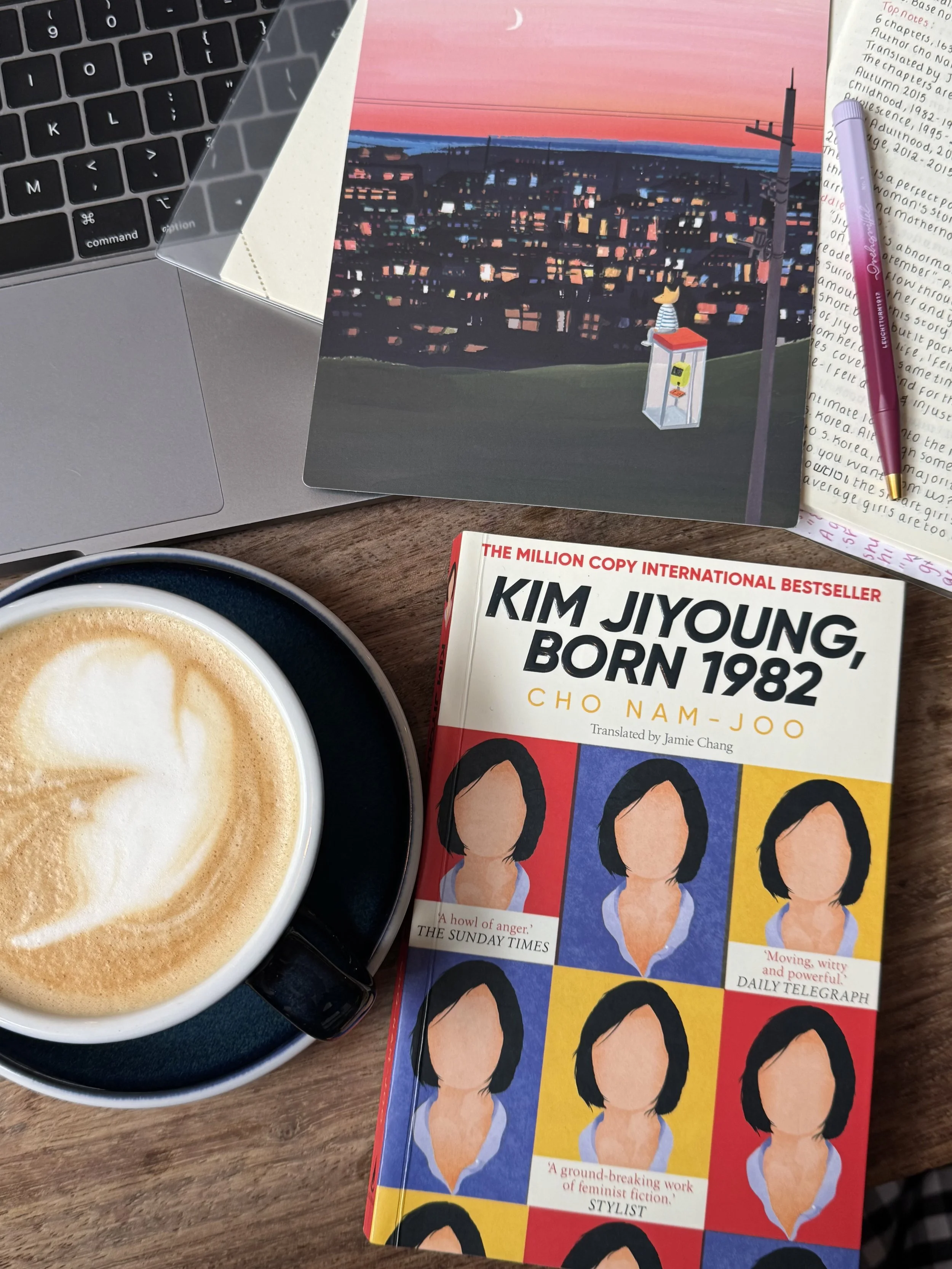
How I review books:
Top notes - a first impression. A practical summary of everything you need to know, including a completely biased view on how much I liked the cover.
Middle notes - the foundation. Readability / structure and characters.
Base notes - the impression. Interpretation and everything else.
Contains some spoilers.
Top notes:
6 chapters, 163 pages.
Author Cho Nam-Joo. First published in Great Britain by Scribner 2020.
Translated by Jamie Chang from Korean; 82년생 김지영.
The chapters are split across:
Autumn, 2015
Childhood, 1982-1994
Adolescence, 1995-2000
Early adulthood, 2001-2011
Marriage, 2012-2015
2016
The cover is a perfect portrayal of the story within, a faceless woman. This is one woman’s story, but it could be anyone’s story of; life, marriage and motherhood.
Middle notes:
“Jiyoung’s abnormal behaviour was first detected on 08 september”
As a reader you flow through Jiyoung’s life, the people and the events surrounding her. You are left angry and exasperated at the amount of this story you can identify with. I am neither married nor a mother but that didn’t take away from my ability to engage fully with this story.
At 163 pages this is a short book, but it packs in so much. Reading through the chapters of Jiyoung’s life I felt both attached to her and distant from her at the same time. I could identify with many of the themes covered and for the themes for which I have no personal experience, I felt anger and injustice for not just her - but all women.
This is an intimate look into the reality of being a woman and a mother in S.Korea. Although some instances within this book are specific to S.Korea, the majority are not.
The key themes for me whilst reading were:
The prioritisation of men in society, from childhood through to the workplace and relationships.
The excusal of poor behaviour towards women.
Marriage.
Motherhood.
Assumed childcare responsibilities.
Sexual harassment.
The burden of being a woman.
The perceived burden of women.
Base notes:
If you want a book that makes you feel seen - yet makes you feel angry, then this book is for you. I found myself angry, sad and everything in between at various points of this book. From the subtle to the outright horrific - the burden of being a woman is evident through Jiyoung’s life experiences.
We start the book at the beginning of Jiyoung’s ‘breakdown’ in Autumn of 2015 and then follow her life chronologically from the beginning through to 2016.
Chapter 1 - Autumn 2015
Kim Jiyoung is 33, she used to work at a marketing agency and is married to Jung Daehung who works at an IT company. They have a daughter together called Jiwon.
Chapter 2 - Childhood, 1982-1994
Within this chapter we see the societal importance placed on men in S.Korea during this time. Jiyoung’s experiences of her brother being prioritised and her mother’s experiences of living in a society that wanted sons over daughters.
To read about the history of governmental family planning in S.Korea and it’s impacts this was an interesting read; Birth Rate Transition in the Republic of Korea: Trends and Prospects. Which covers the policies, their impacts at the time and their long lasting impact, up to today.
“Aborting females was common practice, as if ‘daughter was a medical problem’”
Jiyoung’s early experiences of poor behaviour of men towards women and the excuses made for such behaviour are evident from very early in the book. One example of this is Jiyoung being bullied by a classmate and her teacher explains to her that; boys are like that; the teacher laughed. They’re meaner to the girls they like (p.31).
Reading this made me think of the whole ‘boys will be boys’ narrative which teaches us to accept unacceptable behaviour under the guise of ‘love’ and can set a dangerous precedent for what we accept in relationships. I could go on but I will get back to the book review now…
Chapter 3 - Adolescence, 1995-2000
Here we find out about Jiyoung’s school years. The most pertinent of the scenes in this chapter for me was the incident that took place on the bus. A boy from one of Jiyoung’s classes follows her off the bus and blames her for his actions towards her.
“You always fucking smile at me when you pass me handouts. Always flirting with your hi’s and goodbyes and now you want to treat me like a predator?”
The outcome of this incident was Jiyoung’s father blaming her and Jiyoung having to change her life to ‘avoid’ this situation happening again - even though IT WAS NOT HER FAULT. Anger and anguish ensues as a reader.
Chapter 4 - Early Adulthood, 2001-2011
We learn that Jiyoung had her heart set on a career in marketing, where she discovers there is a biased towards hiring men. In one interview she was asked how she would react if a client was ‘handsy’ (p.88). The answer gaining favour with the interviewers being one where men’s (the client’s) bad behaviour is excused and accepted as part of the job.
Another instance finds Jiyoung overhearing a conversation happening about her, following a breakup with her boyfriend. A group are encouraging one of the men to ask Jiyoung out as he has seemingly always had feelings towards her but his reaction to this is ew, that’s like chewing gum someone spat out. I wanted to include that statement because it made me so angry - so sorry reader, I put it here so it would make you angry too. This concept that women are a commodity to be used and can be objectified to as little as a ‘used object’ is APPALLING. This section alone bought up a lot for me. Anyway, get it together… back to my book review…
Chapter 5 - Marriage
When it comes to having children Jiyoung is aware of the sacrifices that this will entail, whereas her husband is naive, in a completely un-empathetic way, to the impact this will have on her.
“And there is one way to stop my parents’ nagging for good.
What?
Lets just have a kid. If we’re going to have one eventually anyway why not avoid the lectures by just having one.”
“And what will you be giving up oppa?
What
You said don’t just think about what i’ll be giving up”
Jiyoung ends up being the stay at home parent and leaving her job. She has given up everything she worked so hard for. The book describes that this is common; in 2014, around the time Kim Jiyoung left the company, one in five married women in Korea quit their job because of marriage, pregnancy, childbirth and childcare, or the education of their young children (p.133).
This chapter also covers an incident that happened in her former workplace, when catching up with a colleague Jiyoung finds out that there was an incident in the office where spy cameras were hidden in the womens’ toilets. Beyond this the footage had been shared amongst the men in the office. The impact on the women is described and this part of the book was be most enraging and saddening.
“It’ll ruin this company’s reputation if word gets around in the field. the accused males have families and parents to protect, too. Do you really want to destroy people’s lives? Do you want people to find out that your pictures are out there”
“Whilst offenders were in fear of losing a small part of their privilege, the victims were running the risk of losing everything.”
This chapter in particular made me think about what we hear on the news, the stories we hear from family and friends, the secrets we keep because we make other people’s guilt our own. This chapter ends by describing that Jiyoung became different people - all of them were women she knew; truly, flawlessly, completely, she became that person (p.155) - her ‘breakdown’.
Chapter 6 - 2016
I am not going to say too much about this chapter. I wouldn’t want to spoil it - but what a PERFECT final chapter and in a horrifying WHAT THE F*CK sort of a way.
Conclusion
This was a whirlwind read. Even though I have touched on so many of the themes in this book there is so much I haven’t mentioned. You may have a similar experience to me when reading this book or you may read it as an interesting piece of fiction - that is the joy of reading it can be whatever the experience is for you.
I was really taken aback by how much of this book reflected my experiences, the emotions it stirred and the reminder this book provided as to the power of literature to move you, make you reflect and make you feel.
I had to google after finishing this book ‘why did reading Kim Jiyoung, born 1982 make me so angry’. I found solace that, that is exactly how I should be feeling both due to what I have experienced and found reflected back to me in this book but also the layers upon layers of systemic misogyny that I experience(d) and had never put a name to.
I would recommend this book to anyone - if you read this book come back and let me know what you thought of the final chapter.
Ms ASK